
Criminal Cases in the Carter County Courts
Carter County is part of Tennessee's First Judicial District. General Sessions Court conducts initial appearances, decides bond issues, hears misdemeanors within its authority, and holds preliminary hearings in felony cases. A felony may then go to the grand jury. If the grand jury returns an indictment, Criminal Court handles the prosecution. A misdemeanor appeal can also reach Criminal Court.
The Carter County Circuit Court Clerk keeps the Sessions and Criminal Court dockets, filed charging papers, minutes, judgments, and sentencing orders. Municipal courts serve a narrower city role. They do not replace the county clerk for a felony indictment or state criminal judgment. The First Judicial District also covers Johnson, Unicoi, and Washington counties, but that structure does not merge their files. A Johnson City case belongs with the Carter County clerk only when the event and prosecution fall on the Carter side. Use the incident address and case number to confirm venue.
The official clerk directory shown below confirms the Carter County criminal court records custodian.
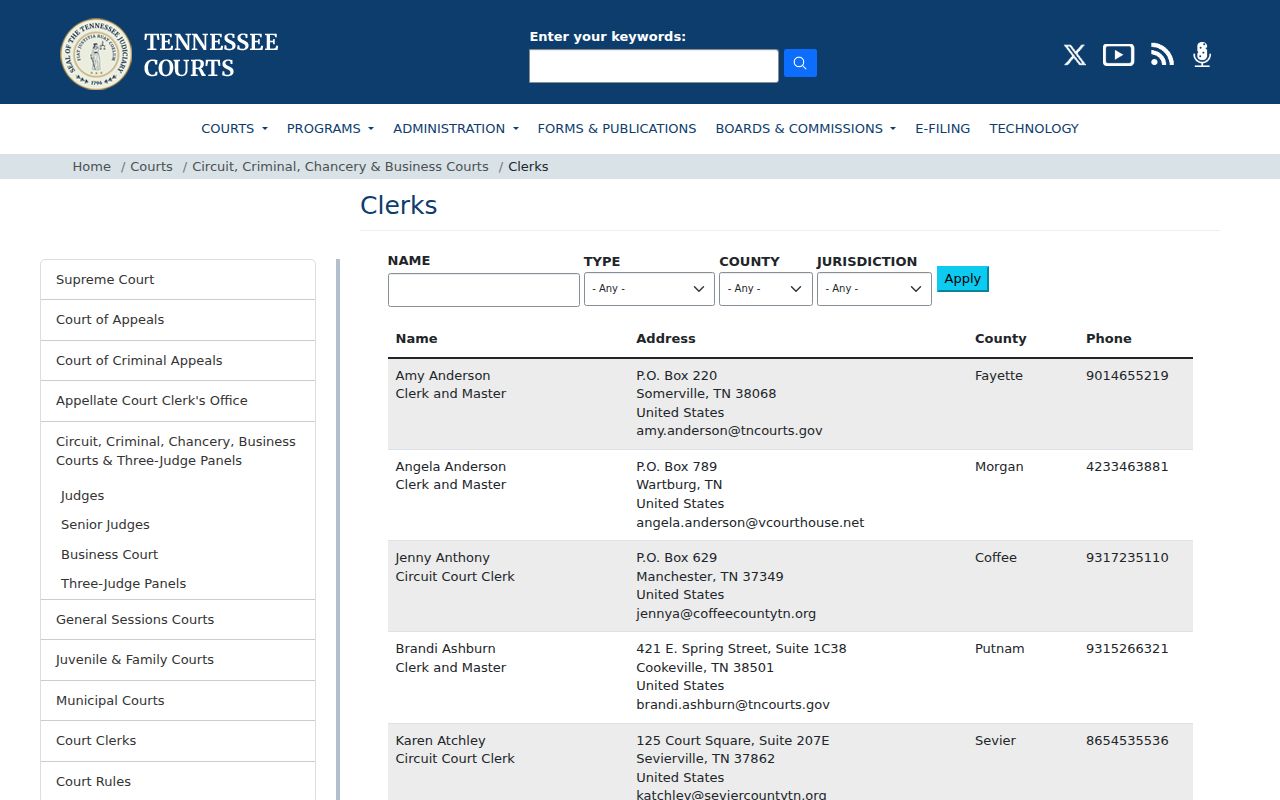
Use its current listing before calling or sending a case request.
Two Carter County Court Addresses
Two official court sources publish different Elk Avenue locations. The AOC courthouse locator lists the Circuit, Criminal, and Chancery Courts at 801 E. Elk Avenue in Elizabethton. The clerk directory lists Circuit Court Clerk Johnny Blankenship at 900 E. Elk Avenue, Suite 906. Both are official. A visitor should call 423-542-1839 before traveling and ask which entrance or suite now handles the needed Carter County criminal case file.
The official courthouse locator view below explains why copying one address from an unofficial directory can send a records user to the wrong counter.
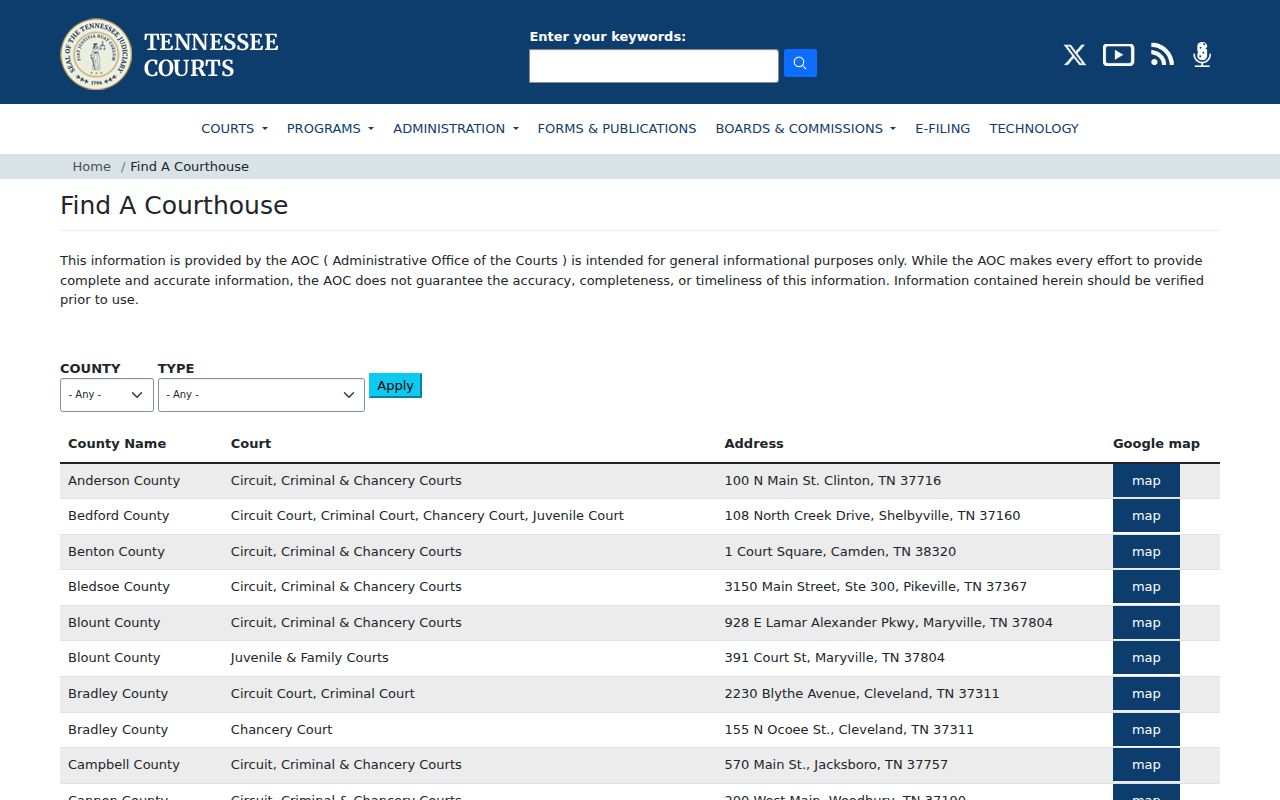
Ask about parking, screening, and accessibility needs during the same call because the reviewed official pages did not publish dependable Carter-specific details.
Note: Call before travel because the court complex and clerk office appear at two separate official Elk Avenue addresses.
How to Search Case Records
No complete public portal for Carter County trial-court cases was confirmed. The clerk's phone and counter service are therefore the main search channel. A clear request saves time, especially for an older file that may be archived.
- Call the Carter County Circuit Court Clerk at 423-542-1839. State whether General Sessions or Criminal Court is likely, if known.
- Give the exact name and an approximate filing or arrest year. Add the case number when available.
- Ask for the docket number and public register of actions first. That index identifies the useful filings.
- Request the indictment or affidavit, judgment, sentencing order, bond order, or other specific document. Ask for a cost estimate.
- Order a certified copy only when certification matters. Check Public Case History and official opinions if the Carter County case was appealed.
The Tennessee court clerk overview confirms that clerks maintain court records and support public access.
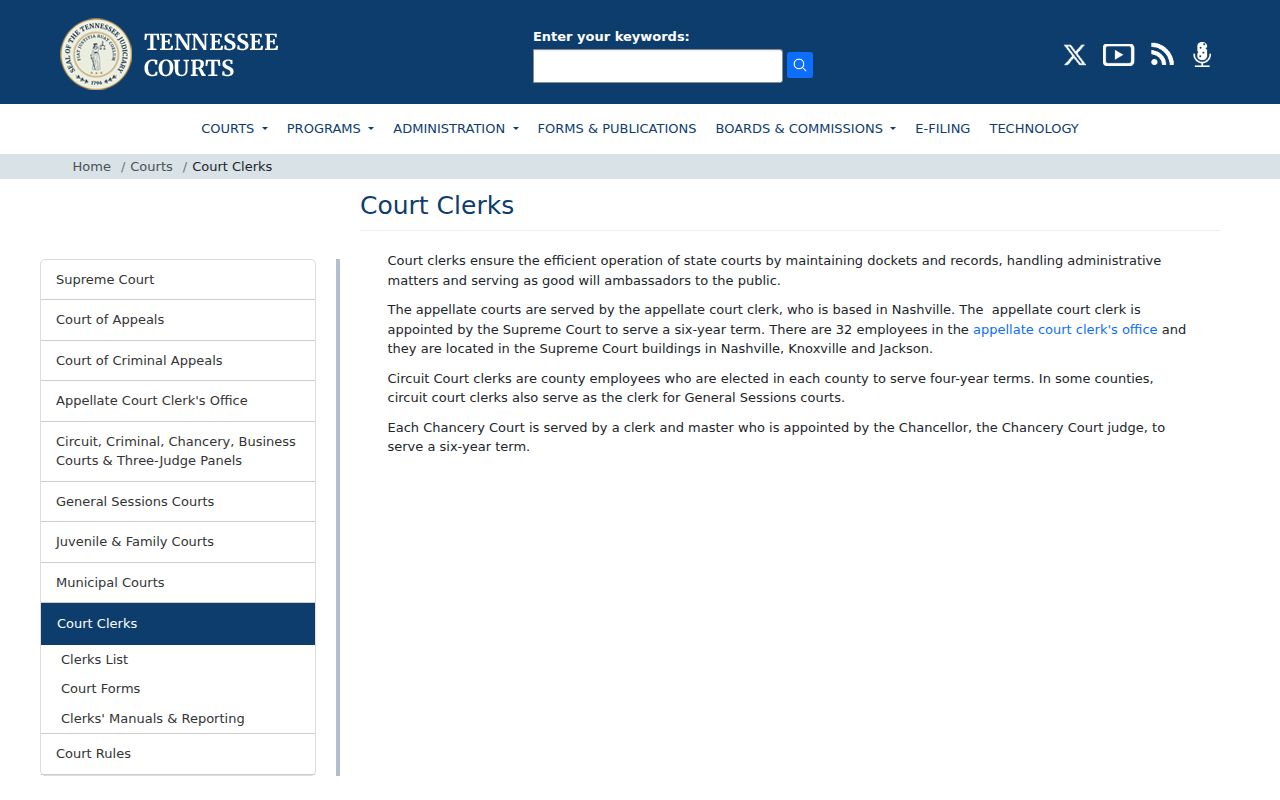
That statewide role becomes a direct Carter County request through the local clerk's office.
Carter County Appellate Case Search
Tennessee Public Case History is an appellate search, not a complete Carter County trial docket. It can help after an appeal begins. A person who searches it first may miss a Sessions or Criminal Court case that never reached an appellate court. Start locally, then use the appellate file to follow later review.
| Field | Type | Required | Notes |
|---|---|---|---|
| Case Number | Text | Optional | Uses an appellate number format |
| Case Style | Text | Optional | Searches the case caption |
| Party Name | Text | Optional | Useful when the number is unknown |
| Business or Organization | Text | Optional | Available where applicable |
| Date Range or Court | Date or dropdown | Optional | Narrows appellate results |
| Search or Clear | Button | Criterion needed | Runs or resets the query |
The official Public Case History interface below shows the statewide appellate layer beyond the Carter County clerk file.
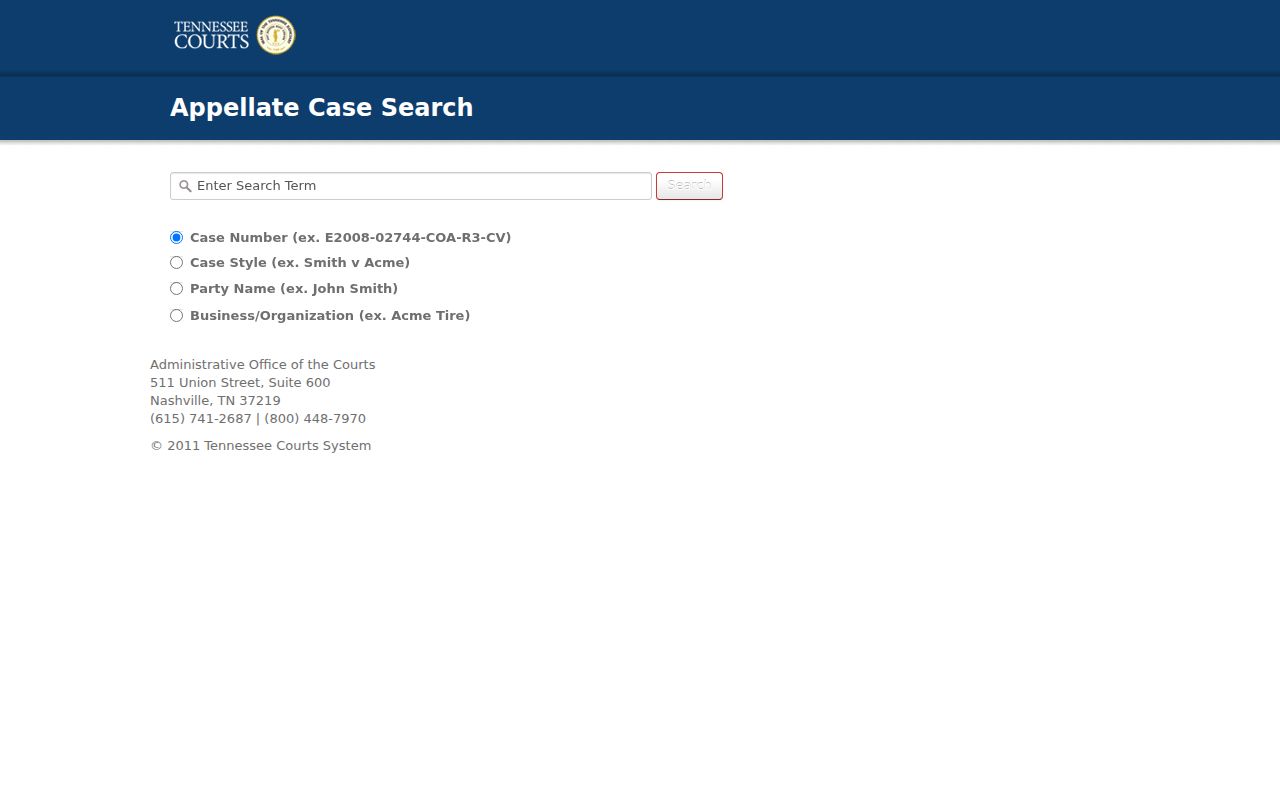
Match the appellate number and caption back to the local docket before treating the records as one case trail.
Note: Public Case History covers appeals and cannot replace a Carter County General Sessions or Criminal Court docket search.
What the Case File Shows
A Carter County court file is arranged by docket number and events, not by the jail's inmate ID. The register of actions gives the sequence. Individual filings supply the legal detail. Charge wording can change between the arrest, affidavit, indictment, plea, and judgment, so compare each count instead of relying on one early label.
| Case Number & Court | The local docket identifier, court, and division that hold the case. |
|---|---|
| Charging Document | An affidavit of complaint, information, or indictment stating the filed counts. |
| Docket Entries | A chronological register of hearings, filings, orders, and later activity. |
| Hearing Dates | Initial appearance, preliminary hearing, arraignment, motion, plea, trial, and sentencing events as applicable. |
| Disposition & Judgment | The outcome for each count, such as dismissal, plea, acquittal, or conviction. |
| Sentence & Conditions | Confinement, suspended time, probation, credit, costs, restitution, and sentence alignment where ordered. |
Other fields can include counsel, bond, offense class, fine, costs, restitution, jail credit, probation, and whether sentences run together or one after another. Post-judgment motions, an appeal number, revocation events, and an expungement order may appear later. Protected data can be redacted. A screen view is useful for orientation, but the clerk's certified judgment is the stronger source when an exact disposition must be proved.
Carter County Sessions and Criminal Court
General Sessions Court is the starting point for many Carter County criminal cases. It handles initial appearances, bond matters, misdemeanor cases within its jurisdiction, and preliminary felony proceedings. Criminal Court handles indicted felonies. Asking the clerk for the wrong court can delay a search, but the arrest charge itself may not reveal where the matter ended.
- Affidavit of complaint
- A sworn factual statement that can begin a Sessions case.
- Preliminary hearing
- A Sessions-stage review of whether a felony accusation should proceed.
- Indictment
- A grand jury's formal charging document that moves a felony into Criminal Court.
- Disposition
- The outcome recorded for a case or for an individual count.
The official General Sessions overview illustrates this lower-court role.
Use the case number and register of actions to confirm whether the Carter County matter stayed there or advanced.
Stages of a Criminal Case
A custodial arrest can begin the record trail, but the court case becomes distinct once a complaint, warrant return, or other charging material is filed. General Sessions addresses the early hearing and bond process. A felony may proceed through grand-jury review and indictment. Criminal Court then handles arraignment, motions, a plea or trial, judgment, and sentencing.
Case flow: Charges Filed › Arraignment › Pretrial › Plea or Trial › Disposition › Sentencing
Later entries may include an appeal, probation or revocation activity, or an expungement order. A Carter County arrest label can differ from the final judgment because prosecutors may amend or decline counts and a grand jury may return different language.
Note: Compare each count through judgment because an arrest charge can change before a Carter County case reaches disposition.
Archived Carter County Case Files
Older Carter County criminal case records may not appear in a modern electronic index. Give the clerk a full name, approximate year, former name when relevant, and any known docket number. Ask whether staff must retrieve an archived file. A broad request for every record about a person is harder to process than a request for a named docket or date range.
Begin with the register of actions instead of ordering the whole file. It can reveal which judgment, indictment, or sentencing order answers the question. Ask about copy costs before production because the research did not locate an official Carter fee schedule. For a historical case, the clerk can also say whether the file remains in court custody or has moved to an archive.
Carter County dates to 1796, but that history does not prove that every old criminal docket survives at the modern counter. Paper files may use older indexes and storage practices. Ask the clerk about the record's date and custody rather than assuming that an absent electronic result means destruction.
Note: A missing online result does not establish that no Carter County criminal case file exists.
Carter County Appeals and Opinions
Public Case History supplies appellate metadata. The judiciary's official appellate opinions search adds published decisions. An opinion may explain legal issues, prior proceedings, and the appellate result, but it does not replace the trial clerk's full file. Not every appeal produces a detailed published opinion.
The official opinions page below is the next step after a Carter County docket reveals an appellate case number.
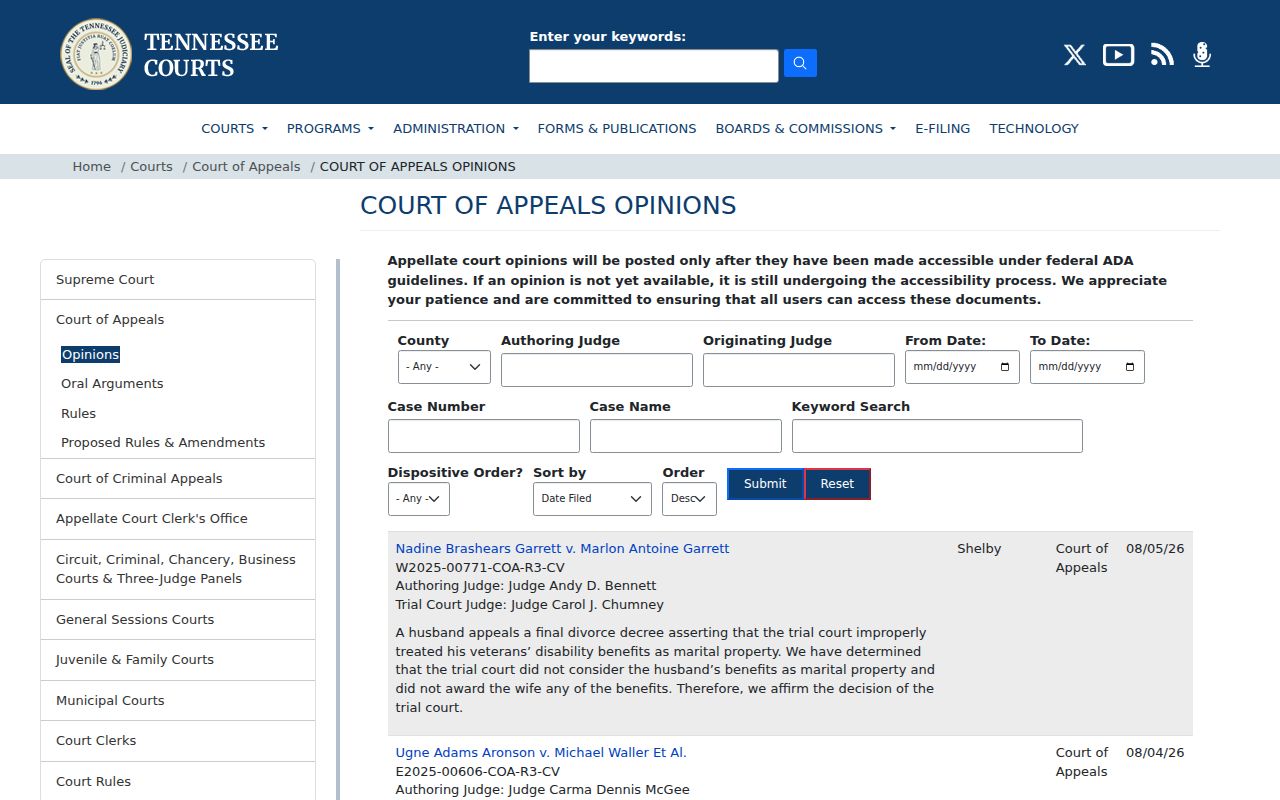
Compare the caption, appellate number, and lower-court docket to avoid joining unrelated cases with similar names.
Access & Restrictions
Tennessee court access is governed by Supreme Court Rule 34 along with statutes that protect specific information. Juvenile matters, sealed or expunged records, protected victim details, personal identifiers, and confidential law-enforcement material may be withheld or redacted. A clerk can release the public portion without disclosing protected fields.
Ask the clerk why a Carter County criminal court case is absent and whether the issue is archive retrieval, a spelling difference, an expungement order, or a legal restriction. A dismissal does not by itself erase a public docket. Expungement under T.C.A. §40-32-101 requires the proper court process. A records request cannot change a case outcome or remove a filed record.
For the wider distinction between booking allegations and filed charges, review the Carter County arrest history process alongside the clerk docket. The two sources can describe the same event with different charges because they capture different stages.